
The $6 Trillion Spreadsheet Upside And The Great Retreat
How Automotive’s Direct-to-Consumer Dream Collapsed and What Comes Next
Founding Partners, Qì Advisory | Frederik Gollob | Felix Weller | Christian Soemmer
This paper examines the decade-long experiment with direct-to-consumer automotive distribution (2016–2026), the consulting-driven narrative that fuelled it, the operational realities that defeated it, and the hybrid omnichannel model now emerging as the industry standard.
Executive Summary
Between 2016 and 2023, virtually every major European OEM announced plans to bypass their dealer networks and sell directly to consumers through agency models. The intellectual catalyst was Tesla; the institutional engine was the global management consulting industry. By late 2025, the experiment had largely failed. Volkswagen fully abandoned its agency model across Europe. Stellantis suspended rollout. JLR, Ford, and Lotus cancelled outright. Polestar pivoted from online-only to traditional dealerships after sales collapsed 15%.
The franchise dealer - long declared dead by consultants - is enjoying a renaissance. Customer satisfaction hit 15-year record highs. Trust in dealers surged from 44% to 69% in just two years. Meanwhile, BYD overtook Tesla as the world’s largest BEV seller using an entirely traditional dealer and distributor model - though its European journey was far from smooth, with early distributor friction and underinvestment in brand-building requiring a painful course correction before results materialised.
This paper traces the full arc: the consulting-driven D2C push, Tesla’s role as a misattributed case study, the operational realities that defeated agency rollouts, and the hybrid omnichannel model now emerging as the industry standard. The core thesis is that Tesla’s distribution model was a product of its unique circumstances - a charismatic founder who carried the brand single-handedly, a first-mover EV advantage, and no legacy dealer relationships - not a replicable template. The seamless online customer journey mattered; the elimination of dealers did not.
The $6.6 Trillion Narrative
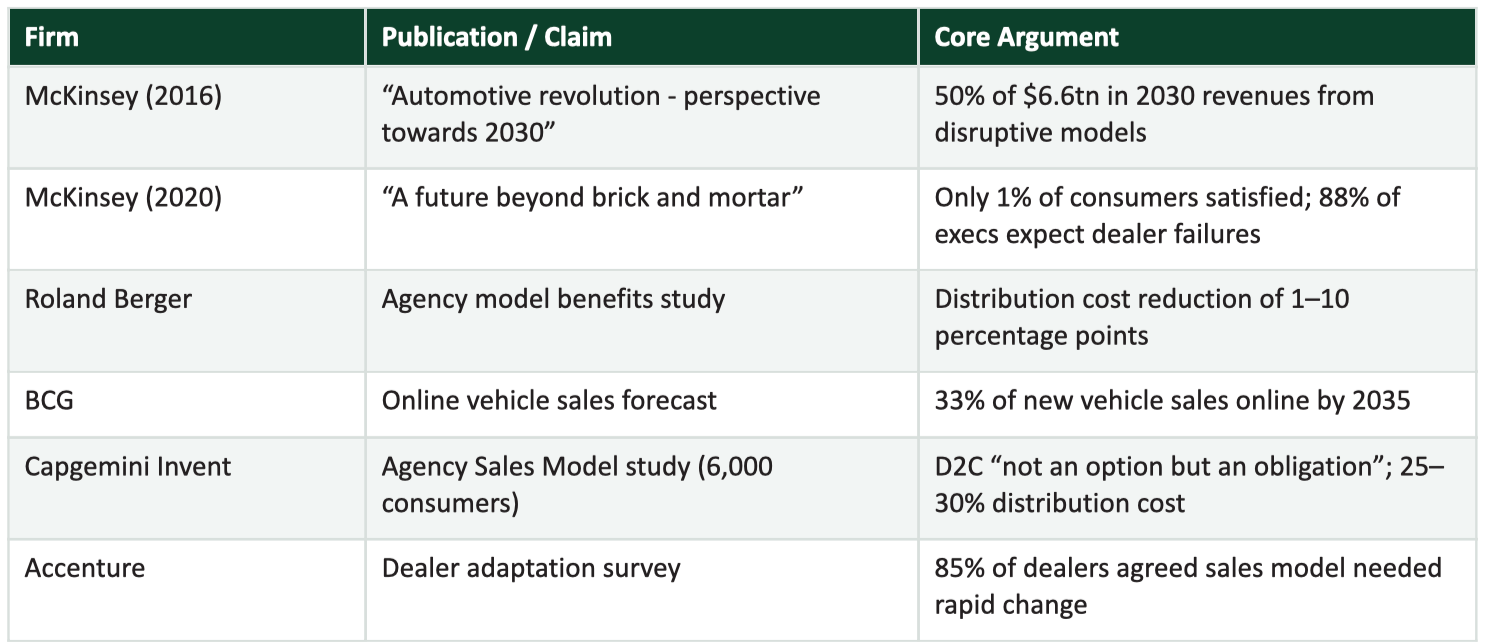
The intellectual foundation for D2C was laid methodically by the world’s largest consulting firms between 2016 and 2022. McKinsey’s landmark 2016 report “Automotive revolution - perspective towards 2030” warned OEMs that 50% of the industry’s projected $6.6 trillion in 2030 revenues would come from disruptive business models, citing Tesla, Google, and Apple as existential threats. This framing - those traditional automakers faced imminent disruption unless they radically reinvented their distribution - became the organising principle for a cascade of consulting publications.
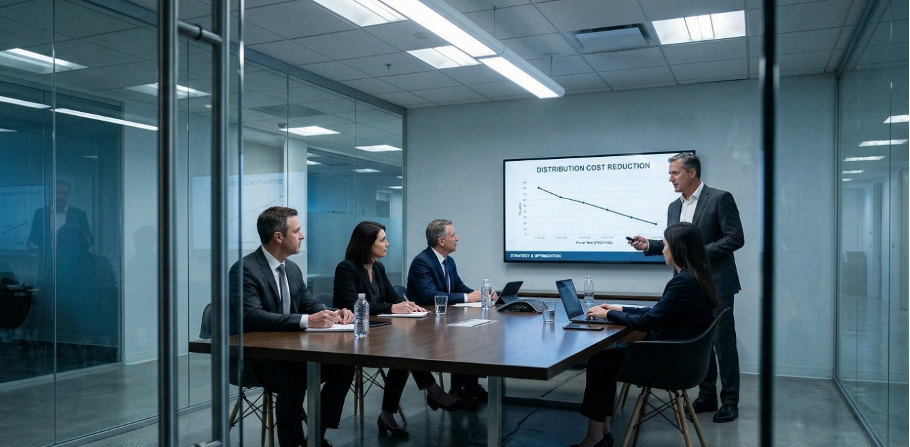
The consulting boardroom, circa 2020: where the $6.6 trillion narrative was built. | AI-generated image
The reports accumulated with escalating urgency. McKinsey’s 2020 study “A future beyond brick and mortar” found that only 1% of consumers were fully satisfied with the car-buying experience, and 88% of automotive executives expected some dealer groups would not survive. Roland Berger quantified the prize: agency models could decrease distribution costs by 1–2 percentage points short-term and up to 10 percentage points long-term. BCG projected online vehicle sales would reach 33% of all new vehicle sales by 2035.
The most aggressive advocate was Capgemini Invent, whose global study of 6,000 consumers declared that moving to a B2C agency sales model was “not an option but an obligation.” Capgemini estimated traditional sales cost approximately 25–30% of a new car’s price and explicitly cited Tesla as industry best practice. The firm developed a proprietary “Agency Sales Framework” - a product it would be paid to implement.
COVID-19 supercharged the narrative. As showrooms shuttered in 2020, every major consultancy published reports arguing the pandemic proved digital-first distribution was inevitable. McKinsey noted that 96% of B2B companies had shifted go-to-market models during COVID. Roland Berger warned that dealer revenues had dropped 20–30%. The message was uniform and urgent: the franchise dealer model was a relic, Tesla had proven the alternative, and any OEM that hesitated risked extinction.
Key Consulting Publications Driving the D2C Narrative
Tesla: A Brand Phenomenon, not a Distribution Blueprint
The entire consulting narrative rested on a fundamental misattribution: that Tesla’s market success was driven by its distribution model. The evidence overwhelmingly suggests otherwise. Tesla’s direct sales approach was a consequence of its unique circumstances - a new entrant with no existing dealer relationships and a charismatic founder who turned a zero-dollar marketing budget into global brand awareness - not a replicable strategic advantage.

Beautiful, sterile, empty: the D2C showroom promised convenience but delivered isolation. | AI-generated image
Elon Musk was the distribution model. Tesla operated with a $0 paid marketing budget for most of its history. Musk’s 180 million social media followers functioned as a direct pipeline to consumers. A single tweet could trigger headlines and pre-orders. The company built a cult following around its first-mover advantage in premium EVs, its Supercharger network (which scored highest in J.D. Power satisfaction at 709 points), and its software-first approach with over-the-air updates.
As Blue Canyon Partners concluded: a unique product can drive a unique distribution model, but in most situations intermediaries such as dealers continue to offer significant value. Tesla’s circumstances were unreplicable - no legacy dealer contracts, a visionary CEO who doubled as chief marketing officer, and a product category (premium BEV) that attracted early adopters willing to tolerate an unconventional buying experience.
The Structural Weaknesses D2C Created
The D2C model created serious structural weaknesses that worsened as Tesla scaled. Service wait times became notorious - owners in 2024 reported waits of up to 52 days for appointments. Unlike traditional automakers with thousands of independent dealer service bays, Tesla must build and staff every location itself. Its vehicle fleet grew far faster than its infrastructure: deliveries rose from 367,000 in 2019 to 1.81 million in 2023, but the vehicles-per-location ratio deteriorated despite locations growing from 644 to 1,553.
The “delivery hell” phenomenon - massive end-of-quarter delivery rushes created by Tesla’s dual role as manufacturer and retailer - produced systemic quality problems. In June 2018, over 85% of Model 3s needed rework before delivery. J.D. Power’s 2020 Initial Quality Study scored Tesla an industry-worst 250 problems per 100 vehicles.
The Musk brand dependency cuts both ways. When Musk’s political activities generated backlash, European Tesla registrations plunged 27.8% in early 2025. A distribution model built on one individual’s personal brand carries concentration risk that no traditional OEM would accept.
Qì Perspective
The “OEM Inefficiency Coefficient.”
Tesla’s structural weaknesses are not unique to Tesla. They are inherent to any OEM attempting to operate its own retail distribution. In our experience advising OEMs across multiple regions and distribution regimes, most manufacturers lack the capabilities to run an efficient and effective retail operation. They lack the local market experience, the customer-facing digital capabilities, and the lean cost structures that professional retailers have built over decades. The result is what we call the OEM Inefficiency Coefficient: the systematic cost penalty an OEM pays when it attempts to replicate in-house what established dealer networks already deliver. This penalty compounds across functions - real estate, staffing, inventory management, service logistics, customer relationship management - and is most acute in the after-sales domain, where dealer service bays absorb complexity that OEMs are structurally ill-equipped to manage at scale.
BYD: The Dealer Model Won - But Not Overnight
The most damning evidence against the D2C thesis came not from legacy OEMs but from BYD, which surpassed Tesla as the world’s largest BEV seller in 2025 with 2.25 million battery-electric sales versus Tesla’s 1.64 million. BYD achieved this using an entirely traditional dealer and distributor model - over 2,200 dealership stores in China and aggressive local partnerships globally. By February 2026, BYD was outselling Tesla in Europe for the second consecutive month. The headline validates the dealer model. But the European journey behind that headline was far rockier than the current momentum suggests.
The Hedin Partnership: Initial Euphoria, Then Friction
BYD entered Europe in the summer of 2022 through an exclusive import partnership with Sweden’s Hedin Mobility Group. The choice was bold but risky. Hedin was a large dealer group, but its expertise was overwhelmingly Scandinavian. In Germany - Europe’s largest and most important car market - Hedin’s presence consisted of a single subsidiary, KW Autohaus GmbH, which operated a showroom in Bremerhaven selling used Dodge and Ram combustion vehicles online. Experience in German sales with electric cars or premium brands it was not.
Initial euphoria among Hedin and the six German dealer groups it contracted to handle BYD sales quickly gave way to disappointment. BYD’s sales targets, set centrally by headquarters in Shenzhen, bore little relation to European market realities. A senior BYD executive in Europe told colleagues in 2023 that the targets were not achievable given weak demand and the need for quality improvements. By the end of 2023, over 10,000 BYD passenger cars sat in storage across Europe with EU type-approval certifications approaching expiry. Germany registered just 4,139 BYD vehicles in all of 2023 - and only 1,432 in the first seven months of 2024.

Over 10,000 BYD vehicles sat in European storage by end of 2023 with certifications approaching expiry. | AI-generated image
The root cause was a fundamental underestimation of brand investment. BYD arrived in Europe expecting product strength to carry the brand, as it had in China. It did not. European brand awareness was negligible. BYD failed to secure the domain byd.de. Its UEFA EURO 2024 sponsorship activation focused on linear television rather than digital and influencer channels, missing younger EV-native audiences. Dealers who had signed up expecting the next Tesla found themselves carrying inventory for a brand that most German consumers had never heard of, with insufficient marketing support and unrealistic volume expectations from an OEM that did not yet understand the cost and effort required to build a brand in Europe from scratch.
The Reckoning: Leadership Change and Distribution Restructuring
The friction came to a head in May 2024, when BYD ousted Michael Shu, its head of Europe, and replaced him with Stella Li - the company’s executive vice president and widely regarded as the number two behind founder Wang Chuanfu. The move signalled that BYD’s European performance was being treated as a top-priority crisis at headquarters level. Li reportedly concluded that Hedin was holding back the German operation. By August 2024, BYD had bought out Hedin Electric Mobility GmbH in Germany, founding BYD Automotive GmbH to take sales, parts distribution, and the Stuttgart and Frankfurt flagship stores into its own hands. Hedin was demoted from national importer to authorised dealer with three remaining outlets. In July 2025, BYD completed the same separation in Sweden - Hedin’s home market.
The restructuring extended beyond Hedin. BYD hired experienced European automotive executives to replace the initial team: Maria Grazia Davino, formerly of Stellantis, took charge of Germany; Alessandro Grosso, also ex-Stellantis, was appointed for Italy. The dealer network was expanded aggressively - up 40% since 2023, targeting 1,000 European points of sale by end of 2025 and 2,000 by 2026. Critically, BYD also shifted its European product strategy, introducing plug-in hybrids alongside its pure-EV lineup to match actual consumer demand rather than the all-electric vision projected from Shenzhen.
The lesson is not that the dealer model failed BYD. The lesson is that even the right distribution model cannot compensate for insufficient brand investment, unrealistic central planning, and an OEM that underestimates what it takes to win in a new market. BYD’s eventual success - S&P Global Mobility forecasts European sales jumping from 83,000 units in 2024 to 186,000 in 2025, reaching nearly 400,000 by 2029 - came only after it corrected its OEM-side failures. The dealers were always ready; it was the brand that needed to catch up.
The D2C EV Startups Fared Far Worse
If BYD’s dealer-model teething problems were painful, the D2C EV startups’ structural failures were existential.Rivian’s stock declined 84.9% since its November 2021 IPO, with the company projecting 2026 EBITDA losses of $1.8–2.1 billion. Lucid lost 96.3% of invested capital since its 2021 SPAC merger. NIO’s European results were particularly instructive: only 398 registrations across Europe in 2024, with Denmark contributing just 5 vehicles. By 2026, NIO was systematically dismantling its European direct-sales structure, replacing it with local distributors - the Nic. Christiansen Group in Denmark, Hedin Mobility in Belgium, AutoWallis in Central Europe. CEO William Li explicitly stated the company was switching to a partnership-based, locally-supported business model. Even NIO’s premium “NIO House” network in China was being cut for the first time as profitability took priority over community-building.

Across Europe, pop-up brand stores closed as quickly as they opened. | AI-generated image
The contrast is instructive. BYD’s problems were fixable - brand investment, leadership, market adaptation - because the underlying distribution infrastructure (dealers, service bays, local relationships) was sound. The D2C startups’ problems were structural: no physical retail presence, no service network, no local partnerships, and no path to profitability without them.
Qì Perspective
Why local dealer partnerships are the fastest path to market.
For new market participants looking to expand into unfamiliar territories, we believe that building long-lasting and trust-based relationships with local dealer partners is not merely a strategic preference - it is the foundation for a fast start. These partners bring existing customer relationships from both car sales and after-sales operations that are far easier and more cost-efficient to activate than building a captive audience from scratch.
The alternative - D2C with all its perceived benefits - requires disproportionately high customer acquisition cost (CAC) spending during a brand launch phase and well beyond. BYD’s experience with 10,000 unsold vehicles in European storage, and NIO’s 398 annual registrations across an entire continent, illustrate the cost of trying to build brand awareness and retail infrastructure simultaneously without local partners absorbing the customer-facing complexity.
The OEM Retreat: Swift, Comprehensive, and Embarrassing
The rollback of agency model commitments between 2024 and 2025 was one of the most dramatic strategic reversals in modern automotive history.
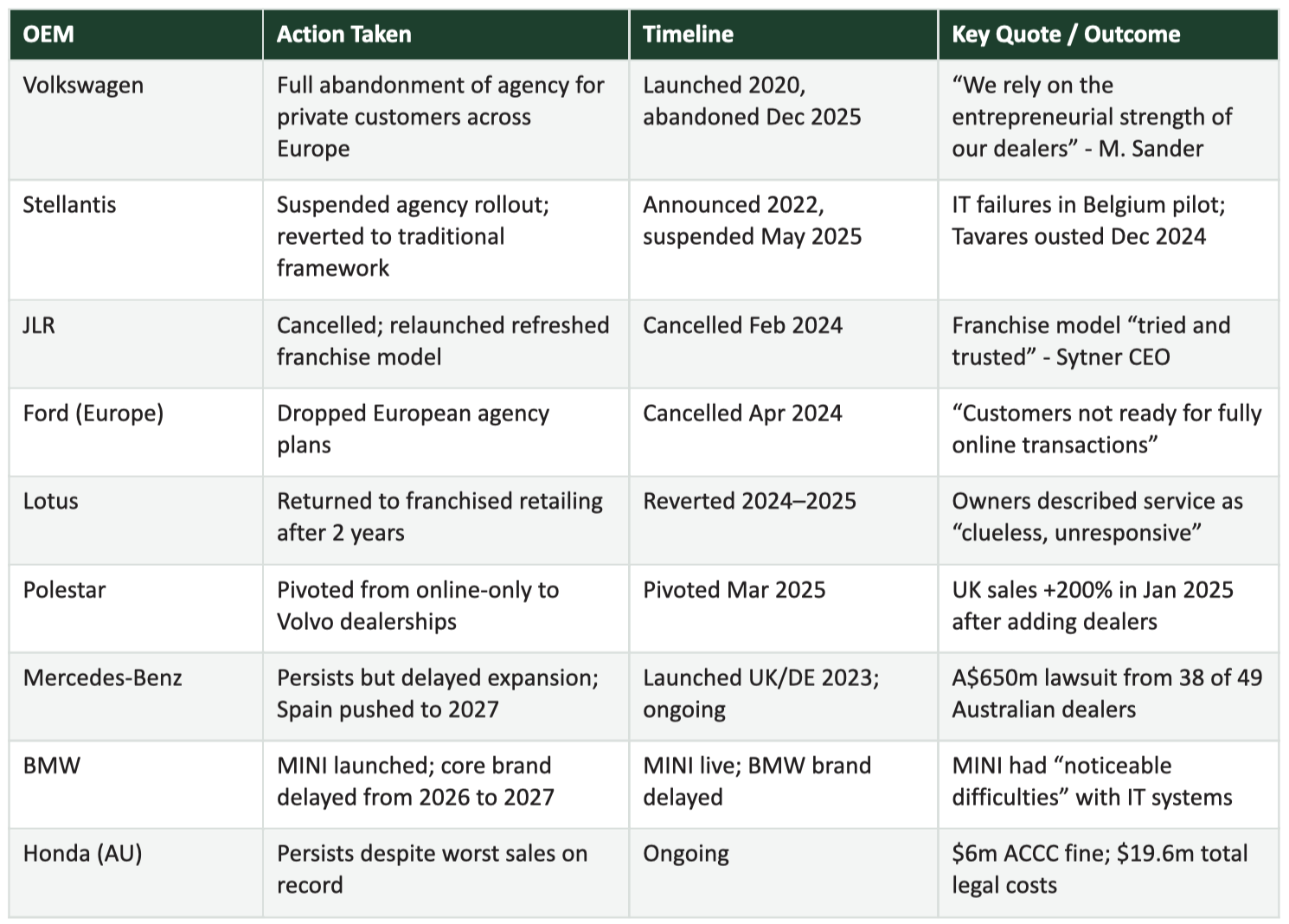
By mid-2025, 71% of UK dealers surveyed by Startline Motor Finance believed the industry-wide shift to agency was “effectively over.”
Why Physical Retail Proved Irreplaceable
The operational failures masked a deeper truth: physical dealerships serve functions that digital channels cannot replicate for high-value, emotionally significant purchases.
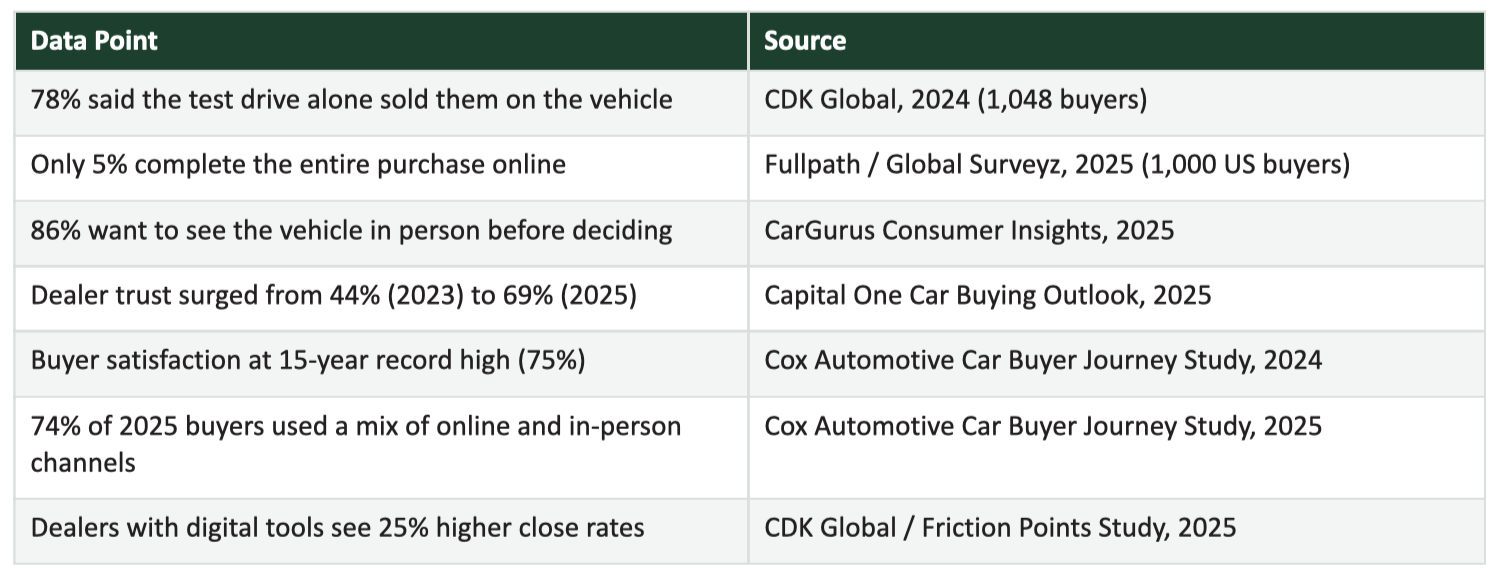
The claimed consumer demand for fully online purchasing proved vastly overstated. While 92% of buyers research online and 83% prefer to do more steps from home, the gap between digital research and digital completion remained enormous. The average buyer now visits just 1.4 dealerships (down from 4.5 a decade ago), arriving pre-informed - but they still arrive.

78% of buyers say the test drive alone sold them on the vehicle. | AI-generated image
Trust in dealers surged precisely as digital tools improved the in-person experience. Buyers familiar with digital tools were even more likely to trust dealers (71%), suggesting that digital preparation enhances rather than replaces the dealership experience.
Regional Perspectives
United States
The US remains the most restrictive environment, with franchise laws in all 50 states protecting approximately 16,900 franchised dealerships representing a $1.2 trillion industry and over one million jobs. Tesla navigated these laws by arguing it never had franchisees, winning favourable rulings in 26+ states and operating 276 locations across 43 states. But the legal landscape is tightening: Florida strengthened bans in 2023, Mississippi barred Tesla from new showrooms, and Rivian sued Ohio in 2025 while winning direct-sales rights in Washington only after threatening a ballot initiative.
Europe
Europe served as the primary laboratory for agency experiments - and the primary graveyard. The EU’s Motor Vehicle Block Exemption Regulation was extended through May 2028, with a new evaluation launched in January 2024. The distinction between “genuine” agency (OEM bears full financial risk) and “non-genuine” agency proved legally and operationally treacherous for every OEM that attempted the transition.
China
China developed the most innovative distribution model, with EV-native brands pioneering factory-owned showrooms inside shopping malls - separating customer acquisition from fulfilment. NIO Houses (187 locations) integrate cafés, libraries, and co-working spaces.
But Chinese brands did not invent this format. Audi City launched on London's Piccadilly in July 2012 - a fully digital showroom with no physical vehicles that drove a 70% sales increase and 60% new-to-brand customers. Audi planned 20 locations; it opened four before closing London in 2018. Mercedes-Benz followed with its Mercedes me Stores from 2014 - Hamburg, Milan, Beijing, Shanghai - blending cafés, art exhibitions, and vehicle display. Beijing closed in 2020; Mercedes said it had "fulfilled its mission." Lexus went furthest with Intersect by Lexus - brand experience spaces in Tokyo (2013), Dubai (2015), and New York (2018) that sold no cars at all. New York closed in 2022 despite being fully booked. Culturally elegant; commercially irrelevant.
What NIO, XPeng, and Li Auto did was not innovation in format but innovation in function. They took a concept that European and Japanese OEMs had treated as a brand marketing side project and made it their primary distribution channel. The difference was necessity: no dealer networks to fall back on.
But even China's market is maturing. Many EV showrooms in prime mall spaces have closed, and BYD dealers have begun failing despite the brand's overall success. Critically, Chinese OEMs expanding globally are systematically choosing local dealer partnerships over D2C - BYD from the outset, NIO after painful miscalculations, and Leapmotor through a Stellantis JV providing instant access to 800+ European points of sale.
Middle East
The GCC maintains concentrated distributor models - family-owned conglomerates like Al-Futtaim and Abdul Latif Jameel holding exclusive national distribution rights - with after-sales contributing 40–60% of revenue. Over 80% of GCC car buyers prefer visiting dealerships. The market is projected to reach $140 billion by 2033. Chinese brands are gaining shelf space through traditional distributor channels, not D2C experiments.
Qì Perspective
The case for multibrand distribution - physical and digital.
One of the least discussed but most consequential implications of the D2C retreat is the growing strategic logic of multibrand distribution setups. In physical retail, this is particularly relevant for expanding coverage beyond Tier 1 and Tier 2 markets (large urban centres) into less densely populated areas requiring larger catchment zones to achieve viable sales volumes. No single brand can economically justify a standalone showroom in a market of 50,000 people - but a multibrand dealer serving three or four OEMs can. As competition intensifies and new entrants multiply, the economics of exclusive mono-brand retail become increasingly untenable outside metropolitan cores.
In digital channels, we encourage OEMs and distributors to study the Chinese marketplace model. Platforms like Autohome - 汽车之家 (Qìchē zhī Jiā) and BitAuto - 易车 (Yiche) have built multibrand ecosystems where customer demand and leads are funnelled and commercialised in a marketplace environment - reducing individual brand CAC while expanding the total addressable audience. We believe both directions - multibrand physical and digital - are increasingly relevant for Europe and the Middle East, where fragmented brand portfolios and rising cost pressures demand more capital-efficient go-to-market structures.
The Emerging Hybrid: Digital Efficiency Meets Physical Trust
The forward-looking consensus is unmistakable: the winning automotive distribution model is a technology-enabled omnichannel hybrid - digital discovery, physical validation, and shared data architecture connecting both channels seamlessly.
The blueprint works in defined stages. Research and discovery happen digitally (92%+ of journeys start online). Configuration and pricing move to online configurators with transparent, consistent pricing. Test drives and vehicle evaluation require physical locations - non-negotiable for 86% of buyers. Financing straddles both channels. Purchase completion and delivery happen at dealerships supported by digital tools. Service combines digital scheduling with physical centres.
Technology is the connective tissue. 25% of new-vehicle buyers engaged AI tools during their 2025 purchase journey, and those who did reported 13 percentage points higher satisfaction. GM’s Digital Retail Platform, used by nearly 1,000 dealers, produces buy rates approximately double traditional channels. The auto dealership CRM market reached $6.79 billion in 2025. AI in automotive retail is growing at 42.8% CAGR.
Data ownership remains the unresolved battleground. OEMs want direct customer data for lifecycle revenue; dealers argue no data enters any system without starting at the dealership. The emerging resolution has OEMs setting CRM frameworks and technology standards while dealers execute daily customer relationships.
Qì Perspective
CAPEX demands must match market reality, not brand aspiration.
Adjacent to the multibrand imperative, OEMs - particularly in volume segments - need to fundamentally reconsider the CAPEX requirements they attach to their brands. As competition intensifies with new entrants from China and beyond, demanding expensive mono-brand showroom investments from dealers who face declining per-unit margins is not a sustainable strategy. The agency model’s appeal was partly that it promised to shift retail CAPEX back to the OEM - but OEMs discovered they could not afford it either. The resolution is not to push costs in either direction but to reduce them structurally: shared facilities, multibrand service infrastructure, digital-first customer journeys that reduce square-metre requirements, and modular brand experiences within larger retail environments. The era of the cathedral showroom as a prerequisite for brand representation is ending.
Qì Viewpoint - Implications for OEM Leaders and Advisors
Why can we say this with confidence? Because the partners of Qì Advisory have operated under both distribution regimes in detail - D2C and dealer-led - and have been personally involved in the transitions from direct-to-consumer models to distribution partnerships, not once but multiple times, across multiple regions. We are not theorising from consulting frameworks. We are drawing on lived operational experience at senior leadership level inside the organisations that attempted, struggled with, and ultimately recalibrated these strategies. The perspectives that follow are grounded in that experience.
1. Do not confuse a brand phenomenon with a distribution model. Tesla succeeded because of Musk, first-mover EV advantage, and a product that sold itself. The distribution model was incidental. Any strategy built on replicating Tesla’s retail approach without Tesla’s brand equity is destined to disappoint.
2. Invest in digital enablement of dealers, not replacement of dealers. The data is unambiguous: digital tools enhance dealership performance. Dealers with full online capability see 25% higher close rates. The goal is a seamless handoff between digital research and physical experience.
3. New market entrants must build trust-based local partnerships - and invest in brand alongside distribution. BYD’s European experience proves that even the right model cannot compensate for insufficient brand investment or unrealistic headquarters-driven targets. BYD’s eventual success came only after it corrected its OEM-side failures. NIO’s experience was worse. The pattern is clear: existing dealer relationships from car sales and after-sales operations are far easier and more cost-efficient to activate than building a captive audience from scratch. D2C in a brand launch phase requires disproportionately high CAC spending - and most OEMs lack the capabilities to operate efficient retail anyway. We call this the OEM Inefficiency Coefficient.
4. Embrace multibrand distribution - physically and digitally. OEMs need to endorse multibrand setups for both physical and online channels. In physical retail, this is critical for strengthening coverage beyond Tier 1 and Tier 2 urban markets into less dense areas with larger catchment zones. In digital channels, the Chinese marketplace model - Autohome, BitAuto - shows how customer demand can be funnelled and commercialised in a multibrand environment, reducing individual brand CAC while expanding the addressable audience. Both directions are increasingly relevant for Europe and the Middle East.
5. Recalibrate CAPEX requirements to match market reality, not brand aspiration. Particularly in volume segments, OEMs need to fundamentally reconsider the capital expenditure they demand from dealer partners. Expensive mono-brand showroom investments for dealers facing declining per-unit margins are not sustainable as competition intensifies. The resolution is not to shift costs but to reduce them structurally: shared facilities, modular brand experiences, digital-first journeys that reduce square-metre requirements.
6. Physical touchpoints remain non-negotiable for high-value purchases. 78% of buyers say the test drive sold them. 86% want to see the car in person. Service infrastructure is the hidden bottleneck of D2C - Tesla’s 52-day wait times demonstrate that owning the retail function means owning every downstream obligation. The showroom is here to stay. It just needs to be a better showroom.
In Essence - human beings want to kick the tyres!
The decade from 2016 to 2026 produced an expensive education in distribution economics. The consulting firms that promoted D2C as “not an option but an obligation” made the classic error of extrapolating from an outlier. They correctly identified consumer frustration with the old dealer experience but prescribed the wrong remedy. The solution was never to eliminate dealers. It was to equip them with digital tools - which is exactly what happened, producing record satisfaction scores once implemented.

The hybrid model in practice: digital configuration flowing into physical experience. | AI-generated image
Tesla’s distribution model was a one-hit-wonder. It worked for a company whose founder single-handedly carried the brand, whose product sold itself on novelty, and whose customer base tolerated an unconventional buying experience. None of these conditions are replicable.
The right distribution model is necessary but not sufficient. BYD’s rocky first two years in Europe are as instructive as its eventual success. The dealers were ready from day one; the OEM was not. And the future demands more than choosing between agency and franchise - it demands multibrand flexibility, disciplined CAPEX, digital-physical integration, and genuine partnership between manufacturers and their retail networks.
The agency model is not dead as a concept, but the vision of a fully centralised, dealer-free automotive retail future is.
The dealership adapted, as it has for a century, and proved once again that for a $50,000 emotional purchase, human beings want to kick the tyres!
Qì Advisory
Qì Advisory is an execution consulting firm engaged when strategy exists but momentum has stalled. We embed below leadership level, take operational ownership, and move execution forward in the markets where it matters most - Europe, the Middle East, and across the China–Europe operational bridge. Our engagements are partner-led and operator-driven. We do not produce additional analysis. We run the work.
Frederik Gollob | Felix Weller | Christian Soemmer
Qì Advisory FZ-LLC | RAKEZ, Ras Al Khaimah, UAE | License No. 47031000 | www.qi-advisory.com | info@qi-advisory.de