
Winning Markets You’ve Never Sold In
Founding Partners, Qì Advisory | Frederik Gollob | Felix Weller | Christian Soemmer
This paper examines what it takes for Chinese OEMs to move from the launch decision to a functioning international business - across Europe, the Middle East, and beyond. It draws on direct operational experience across multiple markets and distribution regimes to identify the execution gaps that separate durable international positions from stalled ones.
Executive Summary
Chinese OEMs have closed the product gap. They are launching credibly in the premium segment, integrating technology architectures that foreign manufacturers are now licensing, and committing to charging infrastructure that will define the ownership experience for a decade. The question of whether Chinese automotive brands belong in European and Middle Eastern markets is settled. They do.
What is not settled is how. The OEMs building durable international positions are not necessarily those with the strongest product today. They are the ones that treat execution with the same discipline they apply to engineering - and build the operational capability to deliver it in markets they have never sold in before.
This paper examines the execution gap: the distance between a well-founded market entry decision and a functioning international business. It draws on direct operational experience across Europe, the Middle East, and the China - Europe bridge to identify where expansions stall and what structured execution looks like when it works.
Three findings anchor the argument
Market entry logic does not transfer across regions. Europe, the Middle East, and Asia each carry their own regulatory architecture, distribution infrastructure, and relationship dynamics. A model built for one does not transfer to another without deliberate reconfiguration.
The Middle East rewards operational commitment, not speed. The region is one of the highest-value opportunities available to Chinese OEMs outside their home market - but it does not reward brands that arrive fast without embedded capability. Distributor selection is the highest-leverage decision in the region, and most OEMs make it too quickly.
Execution gaps are structural, not strategic. The OEMs that have stalled in international markets rarely had a flawed strategy. They lacked the operational layer that translates intent into accountability. Local leadership with real authority, disciplined distribution governance, and aftersales infrastructure treated as a brand asset rather than an overhead line.
Qì Perspective
The window is not closing. It is shifting. The brands that move with structural discipline, not just ambition, are the ones that will hold their international positions through the volatility ahead.
The Opportunity Is Real
Chinese OEMs have done something few Western manufacturers expected at this pace. They have closed the technology gap, credibly entered the premium segment, and begun building the infrastructure that turns product presence into market permanence. Over twenty Chinese flagships launched above €80,000 at Auto China 2026. Foreign manufacturers are now licensing Chinese ADAS and E/E architectures for their own global product roadmaps. The debate about whether Chinese automotive brands belong in European and Middle Eastern showrooms is settled. They do.
The question that now matters is a different one. Not whether to expand globally, but how. The structural conditions have never been more favourable: tariff regimes are challenging but navigable for brands with genuine local presence; consumer openness to Chinese-origin products is higher than at any prior point; distribution partners across both regions are actively seeking credible new principals.
What is missing, in most cases, is not ambition or capital. It is structured execution capability on the ground - the operational layer that turns a market entry decision into a functioning business.

Shanghai, Frankfurt, Dubai - three markets, three distinct execution realities.
Qì Perspective
Early entrants demonstrated that Chinese brands can compete on product. The next phase is about demonstrating they can compete on presence: network depth, service & parts supply reliability, brand trust built over time. That is an execution challenge, not a product one.
The Execution Gap - What the Data Shows – a Snapshot
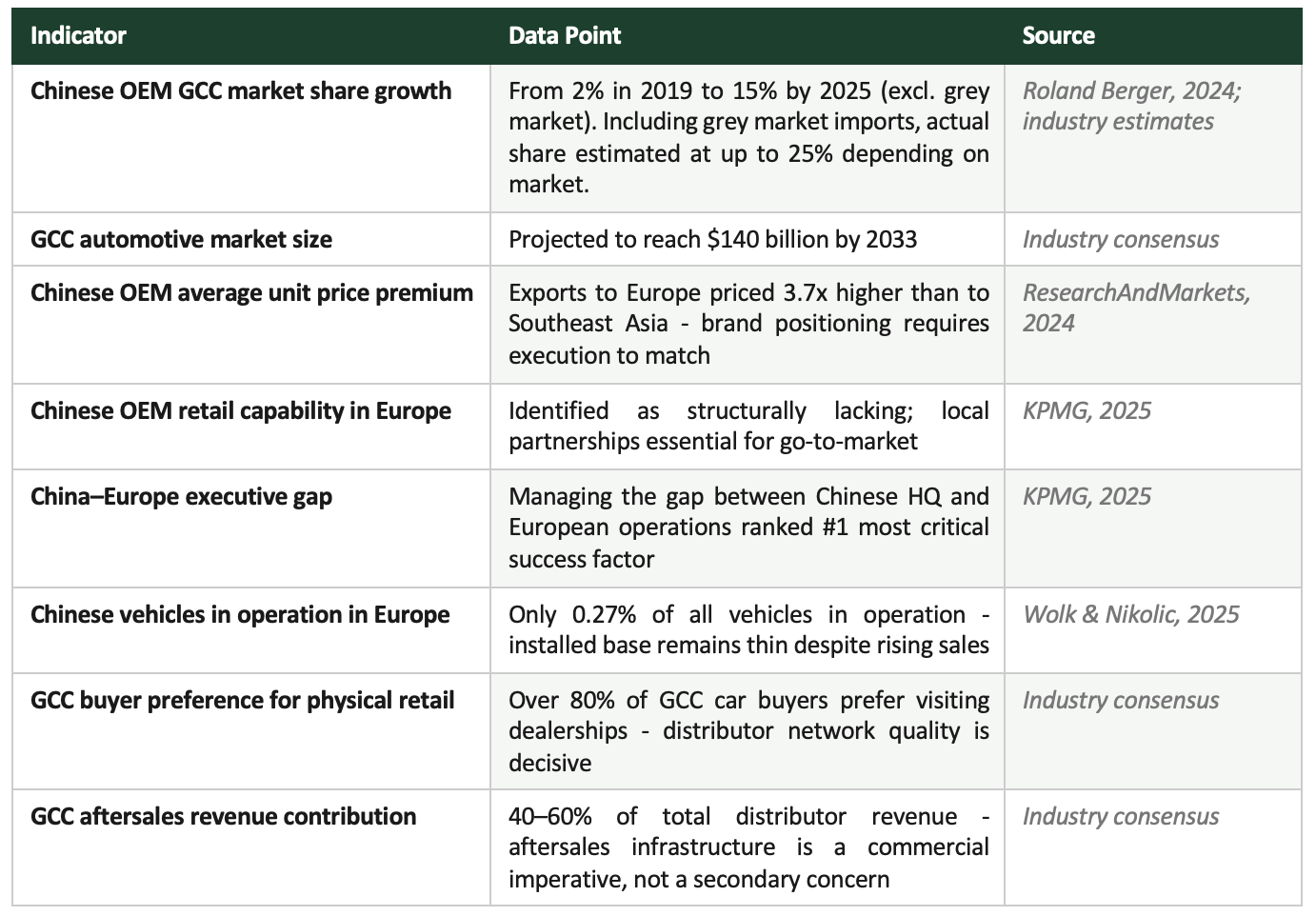
Sources: Roland Berger (2024); KPMG Impact of Chinese OEMs in Europe (2025); ResearchAndMarkets (2024); Wolk & Nikolic After Sales Intelligence (2025); industry consensus.
Three Markets. Three Distinct Entry Logics.
The most persistent error in Chinese OEM international strategy is the assumption that market entry is a repeatable process. Enter one market well, apply the same model to the next. The logic is appealing. The results are rarely what the model predicted.
Europe, the Middle East, and Asia each carry their own regulatory architecture, consumer expectations, distribution infrastructure, and relationship dynamics. A go-to-market model built for one does not transfer to another without deliberate reconfiguration - not just in language or marketing, but in operating structure, network design, and the governance that holds execution accountable.

Strategic planning for unfamiliar markets requires deliberate reconfiguration, not template application.
Europe
Europe is not a single market. Type approval, emissions compliance, and dealer protection legislation vary materially across jurisdictions. Consumer trust in new brands is earned slowly and lost quickly. OEMs that arrive without aftersales capability, clear and effective warranty processes, and genuine network investment find that initial sales momentum does not sustain. The brands succeeding in Europe are those that have committed to the market - not just entered it.
Middle East
The Middle East moves fast - and that speed has caught out more than one OEM that mistook rapid partner interest for market readiness. Over 80% of GCC car buyers prefer visiting dealerships. Aftersales contributes 40–60% of distributor revenue. The region is not a shortcut - it is a long game. The key is long-term distributor relationships built on trust and genuine empowerment of the local partner. Established dealer groups hold the customer relationship and that relationship is the brand’s most valuable asset in the region.
Asia and Beyond
Markets across Southeast Asia and APAC present a different configuration - younger consumer bases, higher price sensitivity, and distribution structures that require local ownership rather than imported operating models. Cultural proximity is not the same as operational readiness. The same structural discipline applies: partner selection, local leadership accountability, and aftersales infrastructure from day one.
Qì Perspective
OEMs that treat market entry as a product launch - announce, deliver, sell - systematically underestimate what comes after the first transaction. Building the operational layer before the sales pressure arrives is the discipline that separates the brands still in these markets in five years from those that retreated. Across all three regions, the common denominator is the same: distributor relationships built for the long term, not optimised for the first quarter.
Focus Topic Middle East: Speed of Entry Is Not the Advantage
The Gulf automotive market is one of the highest-value opportunities available to Chinese OEMs outside their home market. Premium SUV penetration is among the highest in the world. Consumer appetite for technology-forward vehicles is structurally embedded. And unlike Europe, there is much less legacy brand equity that Chinese entrants must dismantle to compete. The GCC market is projected to reach $140 billion by 2033.
What the region does not reward is speed without structure. Brands that arrived early on the back of volume commitments - without aligned distribution partners, localised aftersales infrastructure, or embedded market management - have found themselves locked into relationships that constrain rather than enable growth. Navigating the distributor landscape and the local legal and regulatory framework requires embedded expertise — not a headquarters view from the outside.

The Gulf premium dealership: physical presence and relationship quality define the brand.
Three Capabilities Define Durable Middle East Positions
Distributor selection with genuine governance. Not the largest partner or the fastest to commit, but the partner with the operational infrastructure, financial structure, and cultural alignment to carry the brand for a decade.
Embedded market management. Regional success requires people on the ground with real authority - not headquarters liaison roles. The OEMs building durable Gulf positions have executive presence in region, with P&L accountability and the authority to make decisions at market speed.
Aftersales as a brand asset. In a market where relationships define repurchase, the ownership experience matters as much as the product. OEMs that invest in aftersales infrastructure from day one retain customers.
Qì Perspective
The distributor relationship is the brand’s ceiling in the region for a decade. In the Middle East, the distributor is not a sales channel. It is the operational expression of the brand. We have seen brands with genuinely competitive products underperform for years because the distributor relationship was built on volume expectations rather than shared operational standards. Correcting a distributor relationship after the fact costs two to three years of momentum. Navigating the legal and regulatory landscape in the GCC is a distinct capability — and one where embedded regional experience is non-negotiable.
What Structured Execution Looks Like
Across the engagements where Qì Advisory has been embedded - in Europe, the Middle East, and across the China–Europe operational bridge - a consistent pattern separates successful international expansions from stalled ones. It is not product. It is not capital. It is the presence or absence of structured execution capability at the market level.
In one European distribution transformation, an OEM had entered the market with credible product and genuine brand ambition. What it lacked was an operating model suited to the market it had entered. Dealer relationships were managed from headquarters. Aftersales processes were carried over from a different market context. The network was structured around volume targets rather than sustainable retail economics.

Execution infrastructure: aftersales capability is the hidden differentiator in new markets.
The transformation required six months. Not to rebuild the strategy - the strategy was sound. To rebuild the operating infrastructure beneath it: governance structures, dealer accountability frameworks, localised processes, and a leadership model that gave the market team genuine authority to act.
The pattern holds across markets. Execution gaps are not strategic failures. They are structural ones - the absence of the operational layer that translates intent into accountability.
Qì Perspective
The strategy was not the problem. The gap between strategy and market reality was. The partners of Qì Advisory have operated under multiple distribution regimes across Europe, the Middle East, and Asia - and have been personally involved in the transitions from stalled expansions to functioning businesses, more than once, across more than one region. What we observe consistently is that the organisations with the best outcomes staffed the execution layer with operators, not planners - and gave those operators the authority to act.
Six Principles for Structured International Execution
1. Treat every market as a distinct entry. Resist the template. Europe, the Middle East, and Asia require reconfigured operating models - not adapted versions of the last market entered.
2. Select distribution partners through a structured process, not relationship shortcuts. The distributor or dealer partner carries the brand at the market level. That decision deserves the same rigour as a product development commitment.
3. Staff the market with operators, not liaisons. Local leadership with real P&L accountability and genuine decision-making authority is the single most reliable predictor of execution quality.
4. Invest in aftersales from day one. Service infrastructure is not a phase-two priority. It is the mechanism through which first-time buyers become retained customers - and retained customers become brand advocates.
5. Build brand alongside distribution. Product strength does not carry brand awareness in unfamiliar markets. The OEMs that treated brand investment as separable from distribution investment learned this the hard way.
6. Accept that structural transformation takes six months, not six weeks. Execution timelines driven by headquarters reporting cycles rather than market realities produce superficial change. Durable transformation requires the time it requires.
In Essence
The years ahead will separate two kinds of Chinese OEM. Those that treated international expansion as a product decision - launch the right car, set the right price, find a distributor - and those that treated it as an operational commitment. The first group entered markets. The second group is building positions in them.
The execution gap is not a mystery. It is a structural absence: the missing layer between a well-founded strategy and what actually happens at the dealer, in the service bay, and in the relationship between a brand and its first thousand customers in a new market. That layer does not appear automatically. It has to be built - deliberately, before the sales pressure arrives, with operators who have real authority and real accountability.
The data is unambiguous on the opportunity. Chinese OEMs have moved from 2% to 15% of GCC market share in six years. They are launching credibly above €80,000 in Europe. Foreign manufacturers are licensing their technology. The product argument is won. What remains is the execution argument - and it is being won and lost market by market, distributor relationship by distributor relationship, aftersales appointment by aftersales appointment.
The brands that will hold international positions through the volatility of the next five years are already building this capability. They are not waiting for headquarters to approve a local leadership structure. They are not signing the first distributor who showed interest. They are not treating aftersales as a phase-two problem. They are operating with the discipline that the market demands - not the discipline that feels comfortable from Shenzhen, Shanghai, or Beijing.
The window is open. The question is whether to walk through it with a strategy or with an operation.
Qì Advisory
Qì Advisory is an execution consulting firm engaged when strategy exists but momentum has stalled. We embed below leadership level, take operational ownership, and move execution forward in the markets where it matters most - Europe, the Middle East, and across the China–Europe operational bridge.
Our engagements are partner-led and operator-driven. We do not produce additional analysis. We run the work.
Frederik Gollob | Felix Weller | Christian Soemmer
Qì Advisory FZ-LLC | RAKEZ, Ras Al Khaimah, UAE | License No. 47031000 | www.qi-advisory.de | info@qi-advisory.de